New to Cloth Diapering?
If you are thinking about using cloth diapers for the first time, it can be overwhelming to surf through all the different products, styles, and perspectives! We are here to make using cloth diapers as easy as possible. We have been providing high-quality, reliable cloth diapers to families since 2005. If you have any questions, feel free to call us at 607-272-1237, send us an email, or send us a Facebook message and we will get back to you with honest, practical advice ASAP!
Cloth Diaper Fact vs. Fiction
Fiction |
Fact |
Cloth diapers are hard to care for |
Cloth diapers are so easy to care forPerhaps cloth diapers were hard to care for at one time. But modern cloth diapers are so easy - with inventions like the diaper sprayer and flushable liners, the rewards are worth the little bit of extra work. |
Cloth diapers leak |
Cloth diapers leak less than disposablesOld cloth diapers and poorly designed covers definitely leaked. But modern cloth diapers actually leak less than disposables! Did you know that many moms actually switch to cloth diapers because they were fed up with disposables leaking? Yes, it's true! |
Cloth diapers will give
|
Cloth diapers minimize diaper rashThe rate of diaper rash has increased from 7% to over 78% since 1955, comparable with the increased rate of disposable diaper use. The chemicals, ultra-absorbent gels, and the formation of ammonia associated with disposables are the culprit. We have met many moms who finally switched to cloth diapers specifically to help their baby's bottom heal. Of course, they never turned back! |
Cloth diapers require
|
Cloth diapers are easy to cleanThere are two wonderful inventions that eliminate dunking your cloth diapers in the toilet: a diaper sprayer and flushable liners. The poop of exclusively breastfed babies is actually water-soluble: so, while your baby is an infant, just drop the diaper in your diaper pail and let your washing machine do the work during the initial rinse. After your baby starts solids, you can use a biodegradable, flushable liner. Just pull the liner out of the diaper and drop it into your toilet! In between these times, when your baby is just starting solids, the Mini-Shower makes cleaning easier. |
Cloth diapers are expensive |
Cloth diapers can save you thousands of dollarsDepending on which cloth diapering system you decide to use, you can save approximately $1,500 per child. If you decide to use the same cloth diapers for two children, you can save $4,000! |
Cloth diapers require pins |
No diaper sold on our site requires pinsThat's right! Gone are the days of sticking you or your baby with a pin! Yikes, who would want that? Modern cloth diapers use snaps, Velcro/Aplix, or a wonderful invention created by a dad: a Snappi! Another option is the ABZ Diaper Fastener. |
It's debatable whether cloth
|
Cloth diapers are best for the environment - hands down!We are aware that early studies of cloth diapers and disposables indicated that cloth diapers pollute just as much as disposables. These early studies were funded by disposable diaper companies. Recent studies done by independent researchers indicate that without a doubt, cloth diapers are better for the environment. |
Sorting through different types of cloth diapers

|
Prefolds & FlatsPrefolds & flats are the most economical and versatile way to cloth diaper. Prefolds and flats are soft, absorbent, and can be adjusted to fit your baby. Pins are no longer needed to fasten prefolds - just use a Snappi! Another option is the ABZ Diaper Fastener. Yet another option is to just fold a prefold or flat diaper into thirds and lay inside a cover, which means you don't need to fasten it! (A waterproof cover is needed.) |
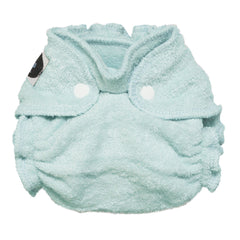 |
Fitted DiapersFitted diapers are shaped like disposables and close with snaps or Velcro/aplix/hook & loop. The big advantage to a fitted diaper is that most have elastic at the legs and back, which makes them excellent at containing messes. Not all fitted diapers contain messes equally though, but many brands (including Nicki's Newborn Bamboo Fitteds and Esembly Inners) are known for being virtually leak-free (one of the best newborn diapers). By using a fitted diaper instead of prefolds or contours, your covers will get dirty less often, leaving them available for reuse. (A waterproof cover is needed.) |
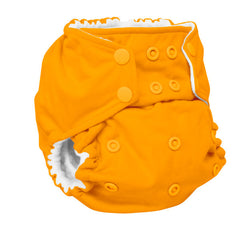 |
Pocket DiapersWhoa, cloth diapers have come a long way! These diapers keep your baby's skin dry and rash-free, are easy to use, and dry quickly. They consist of a waterproof outer layer sewn to an internal layer of fleece. An absorbent insert is stuffed between these two layers. When your baby pees, the moisture travels through the fleece and is absorbed by the insert, leaving only the dry fleece touching your baby's skin! Many people consider these "All-In-Ones" because no additional cover is needed. Some brands offer the choice of snap or hook & loop closure. Any absorbent material that fits can be stuffed inside a pocket. Popular insert fabrics include microfiber, bamboo, hemp, and cotton/poly blends. The most popular option is a one-size (meaning they fit from 12 lbs through potty learning) pocket diaper. (An insert is needed, most diapers come with inserts when purchased new.) |
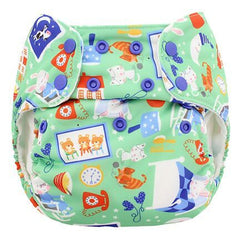 |
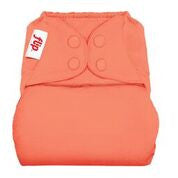
All-in-One DiapersAll-In-Ones are truly as easy to use as disposables! These diapers are very similar to pocket diapers, except the absorbent part of the diaper is sewn to the inside of the waterproof outer. That means you don't need to "stuff" the diaper with an insert; there are no extra pieces or parts! All-In-Ones are ready to use... no additional cover or insert is needed. Some popular All-in-Ones include the bumGenius! Freetime, bumGenius Elemental, Blueberry Simplex, La Petite Ourse All-in-Ones, and GroVia O.N.E. All-in-Ones are among the trimmest cloth diapers available. |
 |
Hybrids / All-in-TwosHybrids are a waterproof cloth outer with a cloth inner OR a disposable inner. All-in-Two means that the system has two pieces, most often a cover/shell and an absorbent insert that can ideally be switched out when wet, while you reuse the cover or shell. Popular for travel when cloth diapers are not an option, you can lay a disposable insert inside the cover. |
Which cloth diapers are best for us?
Which diapering system is best for you and your baby depends on what is most important to you. Would you like the least expensive diapering system? Do you want to use diapers that are environmentally friendly? Do you want the trimmest cloth diaper available? Or would you simply like the easiest to use cloth diaper? Read on! (Keep in mind that many parents use a combination of different diapering systems and that their favorites change as their baby's needs change.)
What is the least expensive diapering system?
There are two cloth diapering systems that are the least expensive. The first would be to use prefolds and covers. The second option is to use a "one-size" diapering system. Keep in mind that while one-size diapers typically last through potty learning, they don't fit newborns very well. We recommend starting with a one-size diaper when your baby is 12 lbs (2-3 months old). Here are some favorite one-size systems: La Petite Ourse One-Size Pocket Diapers, GroVia O.N.E., Rumparooz One-Size Pocket Diapers, Thirsties Stay-Dry Natural All-in-Ones, and Blueberry Organic Simplex All-in-Ones.
Which cloth diaper is as easy as disposables?
Well, most cloth diapering moms feel that any type of cloth diaper is as easy to use as a disposable with a little practice. But, for those a little hesitant to make the switch to cloth diapers, we recommend an all-in-one or hybrid/all-in-two system. For babies over 12 lb., give the Blueberry One-Size Simplex or Flip system a try!
Which cloth diaper is best for newborns?
A well-elasticized newborn fitted diaper will contain the runny, newborn messes that newborns are so well known for! Some examples of this include the Nicki's Bamboo Fitted or Esembly Fitted. Match this fitted diaper with a Thirsties Cover, or Rumparooz Newborn Cover and your newborn days will be care-free! Want a newborn diaper that may leak slightly more than a fitted (still a lot less than disposables!), but is easier to use? Try the Thirsties Newborn All-in-One or Blueberry Newborn Simplex All-in-Ones.
Which cloth diaper contains messes the best?
Kissaluvs fitted diapers are known for containing the runny poop of breastfed babies. Since these diapers are no longer made (we often still have them gently used, just ask!), we had to find the closest model, and have turned to the Nicki's Newborn Bamboo Fitteds. Here's what makes these diapers work so well: the thick, deep-pile bamboo stops poop in its tracks and the stretchy, snug fit around the thighs and back keeps it from escaping. If you use Kissaluvs or Bamboo Fitteds for the first six months, you will have virtually no blowouts... much better than disposables!
Which cloth diaper is best for night time?
Many parents use a pocket diaper (La Petite Ourse, Rumparooz, or Thirsties) with two or three inserts for night time, naps, and long trips. For very heavy wetters (for example, babies who nurse through the night), we recommend a super absorbent fitted diaper (like a Twinkie Tush Night Night Fusion) and a wool or fleece cover.
Which cloth diapers last the longest?
How long your cloth diapers last will definitely depend on how they are cared for, and the quality of the sewing, materials, and design. We only sell cloth diapers with wonderful sewmanship, materials, and design! Our diaper service quality prefolds tend to last longer than any other diaper. These high quality prefolds can last for 3 - 6 years. Diaper covers typically last for at least 6 months, and sometimes longer if carefully taken care of. Pocket diapers and All-In-Ones tend to last through 3 years, or one to two children.
Snaps or Velcro/Aplix?
In general, snaps last longer than velcro. Pocket diapers and All-In-Ones with snaps may last through a second child, whereas those with velcro will last through only one child. However, if you're handy with a sewing or snap machine, both velcro and snaps can be replaced. Velcro is hands-down easier to get on and off babies. However, older babies may love to pull velcro tabs off! This means that you may want to always have shorts, pants, or a onesie over a diaper with velcro to keep the diaper from coming off.
Which cloth diaper and cover is best for the environment?
You are truly amazing! Not only are you doing your part to preserve the environment by not using disposables, but you also want to use environmentally friendly cloth diapers! We have a great selection of organic, bamboo, and hemp diapers. Some great ones are Blueberry Organic Simplex All-in-One, organic cotton prefolds, and Thirsties Natural Fitted.
How many cloth diapers do I need?
Keep in mind that babies grow at different rates and have different needs. In general, here is how many diapers you will need if you are washing every 1 - 1.5 days:
| Age | Diapers Needed | Waterproof covers needed if not using Pocket Diapers or All-In-Ones |
| Newborn to 5 months (12 diaper changes each day.) |
18-24 diapers | 6-8 covers |
| 5 Months to 1 Year (8-10 diaper changes each day.) |
12-18 diapers | 4-6 covers |
| 1 Year + (4-8 diaper changes each day.) |
8-12 diapers | 4 covers |
What cloth diapering accessories do you recommend?
We recommend starting simple! If you're on the fence about cloth diapering, skip these accessories until your mind is made up! Once you're cloth diapering, you won't want to miss these accessories!
 |
Flushable Liners or Diaper SprayerFor Newborns: The poop of breastfed babies is too runy for flushable liners to work well. They'll just disintegrate! However, a diaper sprayer will make clean-up easy, minimizing stains. |
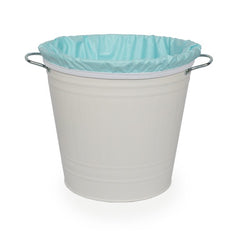 |
Diaper Pail LinersGone are the days of wet pails! Pick up any tall kitchen garbage can at your local store, and use one of these handy pail liners inside of it! When it's time to wash your cloth diapers, just carry the full pail liner to your washing machine. Wash and dry the pail liner along with your diapers. Pail liners transport your diapers and keep your pail clean! It's great to have two pail liners, so you can use your pail when you're washing one liner, keeping a rotation of two. Pail liners are fabulous down the road as laundry bags, bags for beach gear/swimming gear, and more! |
 |
Cloth WipesCloth wipes not only work better than disposable wipes, but they save so much money! You'll need about 18-24 cloth wipes for newborns, and 12-18 for older babies. Choose a different color and use them for hands and faces, too! |
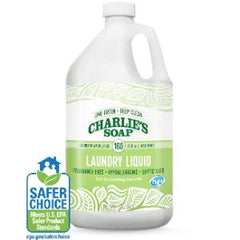 |
Detergent that is Safe for Cloth DiapersYou'll definitely want to choose a detergent that is safe for your cloth diapers, to protect your investment! What do we mean by "safe"? Basically, you want your detergent to rinse completely clean, and you don't want a harsh detergent that will shorten the lifetime of your diapers. See our recommended cloth diaper detergent list here. |
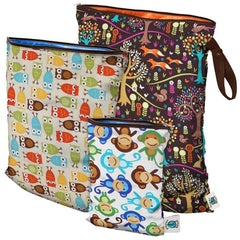 |
Zippered Wet BagWhen you're out and about, you'll want to put your used cloth diapers into a waterproof bag that doesn't leak odors! Either reuse your plastic grocery bags, or use one of these cute zippered wet bags. You'll need one or two. Just wash with your diapers! |
How do I wash cloth diapers?
Please see our washing recommendations here!
How does the cost of cloth compare to the cost of disposable diapers?
Please see our Cost Comparison: Cloth Diapers vs. Disposables for more information!
How many diapers, covers, and accessories do I really need?
We have put together a complete checklist for birth through potty training for three different cloth diapering options and accessories. This will give you an idea of how many diapers, covers, and accessories you may need in any given size along with the associated cost. Remember that high quality, well-known brands have great resale values! You can check out our Complete Checklist options here!
© 2026 Jillian's Drawers.


